
How to Break Concrete with a Pneumatic Breaker
Breaking concrete looks like a contest of brute force, but the crews who do it all day will tell you it is really a contest of setup. Pick a breaker that matches the slab, put the right bit on the end of it, feed it enough air, and use technique that lets the tool do the work - do those four things and a driveway comes apart in tidy chunks instead of a fight. Get any one of them wrong and you burn a shift, bury a bit, and beat yourself up in the process. Champion Chisel Works has supplied pneumatic breakers and demolition steel from Rock Falls, Illinois since 1968, and this is the same advice we give over the phone every week.
Match the breaker to the slab
Pneumatic pavement breakers are sold by weight class, and the class is really a proxy for how much impact energy the tool delivers. A heavier breaker hits harder and moves more concrete per minute, at the cost of being more tool to hold and feed. The trick is to size up to the job without over-buying muscle you will be wrestling all day.
Champion's 30-lb class breaker (AT-PB30-1) is a good reference point. It delivers 1,550 blows per minute on a 3.375″ stroke through a 1-3/4″ bore, weighs 34 lbs, runs about 49 CFM at 90 PSI, and takes 1″ x 4-1/4″ shank chisels. That is the sweet spot for sidewalks, patios, and slabs up in the four-to-six-inch range. When the concrete gets thicker or is heavily reinforced, step up to a 60-lb class breaker - Champion offers them for both 1-1/8″ x 6″ and 1-1/4″ x 6″ shanks - and for foundations and mass concrete a 90-lb breaker is available on request. You can compare the full lineup on our pavement breakers page.
| Breaker class | Typical job | Champion shank fit |
|---|---|---|
| 30 lb | Sidewalks, patios, 4–6″ slabs | 1″ x 4-1/4″ hex |
| 60 lb | Thicker & reinforced slabs | 1-1/8″ x 6″ or 1-1/4″ x 6″ hex |
| 90 lb | Foundations, mass concrete | Available on request |
Pick the right bit - it matters more than horsepower
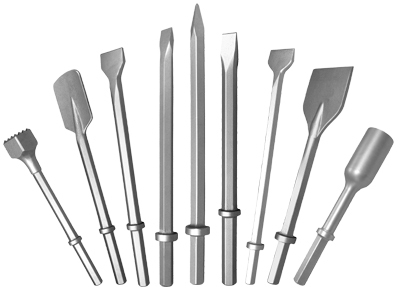
The bit is where the tool meets the concrete, and choosing the wrong shape is the most common reason a capable breaker feels weak. Think of it as a small kit rather than a single tool.
Start with a moil (bull) point. Because all of the breaker's energy is focused on a single point, a moil point is what you use to punch the first hole and start cracks radiating outward. Once you have cracks, switch to a narrow or wide chisel to follow and widen them and to shear along an edge - the flat blade turns point energy into a line of fracture. For asphalt and blacktop, an asphalt cutter with its wide, tapered blade slices rather than shatters, leaving a cleaner cut line. And when the material underneath is compacted soil or clay rather than concrete - trenching, setting posts, digging out around a footing - a clay spade (often paired with a lighter clay digger) moves earth far faster than any concrete bit. Champion stocks all of these shapes in matching breaker shanks; browse the heavy-duty pavement breaker steel line, including the clay spade and asphalt cutter for the 1-1/4″ x 6″ shank. If you want a primer on shapes, our guide to demolition bits breaks each one down.
Technique: let the tool break the concrete
Here is where most of the wasted effort hides. Do not drive the bit straight down into the middle of a slab and lean on it - that just buries the steel and stalls the tool. Instead, work 4 to 8 inches back from a free edge so every blow has somewhere to send the fracture. Let the bit penetrate only an inch or two, then use a slight lever or pry to pop a chunk loose, and move on to the next bite. You are chasing the edge across the slab, breaking material toward open space the whole way.
Keep the bit moving and keep it roughly perpendicular to the surface. Let the weight of the breaker and the blow energy do the work; pushing down harder does not make it hit harder, it only tires you out and risks wedging the bit. If the tool starts to bog or the bit gets pinched, back out and take a smaller bite closer to the edge. Broken concrete comes apart in a rhythm - punch, crack, lever, advance - not in one heroic push.
Feed it air, and keep it oiled
A pneumatic breaker is only as strong as the air behind it. That 30-lb breaker wants roughly 49 CFM at 90 PSI, and a 60-lb tool wants more; if your compressor and hose cannot hold 90 PSI at the tool under load, the breaker will hit soft no matter how good your technique is. Size the compressor to the tool with headroom to spare, and use a hose large enough that you are not choking it at the far end of the run. Finally, keep the tool lubricated with SAE 10W-20 air tool oil - an in-line oiler is the easy way - and dress or replace a bit before the head mushrooms. Every Champion air tool is rated at 90 PSI and backed by a 180-day warranty when it is run and maintained that way.
Frequently Asked Questions
What tool is best for breaking concrete?
For anything from a sidewalk to a footing, a pneumatic pavement breaker is the workhorse. Match the class to the slab: a 30-lb breaker such as Champion's AT-PB30-1 handles slabs up to roughly 4 to 6 inches, a 60-lb breaker takes on thicker and reinforced work, and 90-lb breakers are for heavy foundations. Lighter chipping hammers are better for trim work, not bulk breaking.
What bit should I use to break concrete?
Start with a moil (bull) point to punch through and start cracks, because it concentrates all the energy on a single point. Switch to a narrow or wide chisel to follow and open those cracks and to work along an edge. Use an asphalt cutter for blacktop and a clay spade or clay digger for compacted soil. Always match the bit's shank to your breaker.
How thick of concrete can a jackhammer break?
It depends on the class of breaker and whether the concrete is reinforced. A 30-lb pneumatic breaker comfortably handles unreinforced slabs in the 4 to 6 inch range, a 60-lb breaker moves into thicker and reinforced slabs, and a 90-lb breaker is built for foundations and mass pours. Rebar is cut with a chisel bit once the surrounding concrete is broken away.
Why does my breaker get stuck in the concrete?
Almost always because the bit is driven straight down and buried instead of being used to break material toward a free edge. Work 4 to 8 inches back from an edge, let the bit penetrate only an inch or two, then lever to pop a chunk loose and move on. Keeping the bit moving also prevents it from wedging and the head from mushrooming.
|
2M+
Chisels Forged
|
50M+
Lbs US Steel
|
2,400+
Customers Worldwide
|
Champion Chisel Works, Inc. - family-owned and American-made in Rock Falls, Illinois since 1968. Tough Jobs. Tough Tools. One Source.
| Contact Us | Shop All Tools |